


A bed sheet might look suitable in a product photograph, but you learn much more when you have the fabric in your hands.
You can feel the texture, inspect the stitching and check whether the dimensions match your existing bedding. These details are especially important when ordering for several guest rooms, where even small differences between products become noticeable.
Before committing to a larger order, use this guide to examine bed linen samples and decide whether they meet your requirements.
Before opening the sample, check what you ordered.
A product description should provide enough information to identify the fabric and understand its construction.
Start with the basics:
| Specification | What to Check |
|---|---|
| Fabric composition | Cotton, polycotton or another stated blend |
| Thread count | The stated thread density |
| GSM | Fabric weight in grams per square metre |
| Product type | Flat sheet, duvet cover or pillowcase |
| Dimensions | Length, width and relevant finished measurements |
| Design | Plain, stripe or another woven finish |
| Care instructions | Recommended washing and drying conditions |
Keep the specification alongside the sample. This makes it easier to compare different products without relying on memory or marketing descriptions.
The first thing many people notice about bedding is how it feels.
Run your hand across the fabric and examine both sides. Does the surface feel consistent? Are there any visible changes in texture or construction?
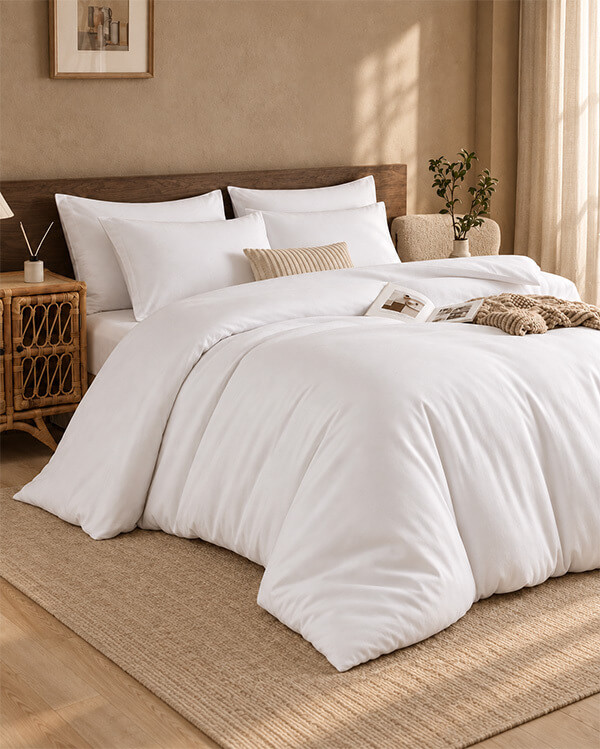
Look at the fabric under good lighting, especially if you’re comparing several white bedding samples.
A slightly different weave or finish can change the appearance, even when two products have similar specifications.
Remember that softness alone doesn’t tell you how a fabric will perform after repeated use. It is one characteristic to assess alongside the others.
Stitching deserves attention because it forms part of the finished product.
Check whether the seams look even and whether loose threads or visible defects are present.
For duvet covers and pillowcases, inspect the openings and closures where applicable.
For flat sheets, examine the hems and corners.
You don’t need specialist equipment for an initial visual inspection. Good lighting and a close look will help identify obvious finishing issues.
If your organisation requires a particular seam construction or stitching specification, ask the supplier to confirm it in writing.
A size label isn’t enough to confirm whether bedding will fit your existing stock.
Use a measuring tape to check the finished dimensions and compare them with the measurements you need.
For example, a flat sheet must provide enough fabric for your preferred bed-making method. A duvet cover must fit the duvet it is intended for.
When reviewing pillowcases, check that the dimensions suit the pillows already used in your rooms.
Record your measurements so you can refer to them when placing a repeat order.
If dimensional tolerances are important, request the supplier’s stated tolerances rather than assuming every sample will measure exactly the same.
Thread count and GSM are useful measurements, but they describe different fabric properties.
Thread count refers to the number of threads woven within a defined area, commonly one square inch.
GSM measures the weight of a square metre of fabric.
Neither figure provides a complete description of the finished bed linen.
When comparing samples, look at thread count, GSM, fibre composition and weave together.
A higher thread count does not automatically mean that one sample is more suitable than another.
A fabric sample often looks different when it is used on a bed.
If possible, test a full-size sample in an actual guest room.
Check how it sits on the mattress, how it looks after fitting and whether the fabric finish suits the room.
For duvet covers and pillowcases, consider how plain and patterned designs work with the other bedding already in use.
This is particularly useful when replacing part of an existing linen collection.
A new product may have the correct dimensions but a slightly different shade or surface appearance.
Before approving bedding, check whether its care instructions match your laundry process.
This matters whether your linen is washed on-site or handled by an external laundry provider.
Ask about the recommended washing temperature, drying method and ironing requirements.
If your operation has specific standards for commercial laundering, request appropriate supporting information.
Do not assume that a product is suitable for a particular wash temperature or number of laundry cycles simply because it is described as hotel bedding.
A controlled sample wash may help you observe changes in appearance, dimensions and feel.
If you decide to run one, follow the manufacturer’s care instructions and record the conditions used.
Compare the washed sample with its original measurements and appearance.
One wash cannot establish long-term durability, but it may identify issues that deserve further investigation.
Where formal performance requirements apply, ask for relevant test evidence.
If you’re comparing products from more than one range, a simple inspection sheet makes the decision easier.
| Inspection Point | Your Findings |
|---|---|
| Fabric composition | |
| Thread count and GSM | |
| Fabric feel | |
| Finished dimensions | |
| Stitching and hems | |
| Colour and appearance | |
| Care instructions | |
| Sample wash observations | |
| Questions for supplier |
You can use this record when discussing a quotation or confirming an order.
It also provides a useful reference for future replacements.
A sample inspection becomes more useful when you compare products with different specifications.
For example, the Thornton Mills bed linen collection includes Valencia, Seville, Iberia and Andalusia.
The ranges differ in composition, thread count and design. Valencia has a plain 130 TC polycotton construction, while Iberia and Andalusia feature satin stripe designs.
These differences give you several points to compare when assessing which fabric suits your property.
You can review the specifications through the Thornton Mills bed linen collection.
Check individual product pages for current sizes, ordering options and availability.
Once you’ve examined the fabric, there may still be details worth confirming.
Ask the supplier:
Clear answers help you make purchasing decisions using actual product information rather than assumptions.
Start with the published specification. Inspect the fabric, seams, hems, dimensions and overall finish. Check its care instructions and consider testing a full-size sample in its intended setting.
No. Thread count should be considered alongside fibre composition, GSM, weave, construction and finishing.
A sample wash may help assess initial changes in appearance and measurements. Follow the product care instructions and use controlled conditions. One wash does not prove long-term performance.
Look at the shade, fabric texture, design, dimensions and finished appearance. If the new bedding will be used alongside existing stock, compare the products directly.
Yes. GSM measures fabric weight, while yarn, fibre composition, weave and finishing influence the feel of the finished fabric.
Choosing hotel bedding becomes more straightforward when you have measurable specifications and a physical sample to review.
Take time to inspect the fabric, check the dimensions and compare the care requirements with your existing operation.
A short inspection before ordering gives you useful information for discussing the product with your supplier and maintaining consistency across future purchases. To compare an available commercial option, review Valencia 130 TC Hotel Bed Linen and its listed specifications.
Enter your email address to access the Thornton Mills profile PDF and explore our hospitality textile range.